Research & Innovation
Explore AeonCore’s approach to research, experimentation, evidence and interdisciplinary innovation across scientific, environmental, agricultural and educational systems.
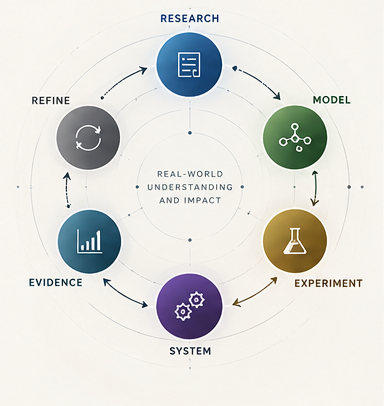
AeonCore treats research as a continuous process of questioning, modelling, testing, learning and refinement.
Its role is not to defend established assumptions or promote unconventional ideas simply because they are different, but to investigate important questions with openness, structure and evidence.
RESEARCH & INNOVATION
Curiosity with discipline.
AeonCore exists to investigate questions that are difficult, interdisciplinary or not yet fully understood.
Its research approach combines openness to new possibilities with a commitment to evidence, transparency, reproducibility and critical examination.
Its research approach combines openness to new possibilities with a commitment to evidence, transparency, reproducibility and critical examination.
Interesting ideas deserve investigation.
Strong claims require strong evidence.
Research Without Artificial Boundaries
Important questions rarely belong to one discipline
Traditional research structures are often organised around established academic or industrial fields.
Those disciplines remain valuable, but complex questions frequently sit between them.
Environmental systems may involve climate science, economics, agriculture, geography, engineering and social behaviour. Educational systems may involve pedagogy, psychology, labour markets, technology and organisational behaviour.
AeonCore therefore encourages research to move across disciplinary boundaries when the question requires it.
Those disciplines remain valuable, but complex questions frequently sit between them.
Environmental systems may involve climate science, economics, agriculture, geography, engineering and social behaviour. Educational systems may involve pedagogy, psychology, labour markets, technology and organisational behaviour.
AeonCore therefore encourages research to move across disciplinary boundaries when the question requires it.
The problem defines the disciplines we need...
...not the other way around.
The Research Cycle
A research cycle built around learning
Question
Define what we are trying to understand and why the question matters.
Evidence
Identify existing observations, research, data and competing explanations.
Model
Build a representation or hypothesis that can be explored.
Experiment
Test assumptions through analysis, simulation, prototypes or real-world observation.
Evaluate
Compare results with expectations, limitations and alternative explanations.
Refine
Improve the question, evidence, model or system based on what was learned.
Research is not a straight line. Each answer should create better questions.
Mainstream and Non-Mainstream Research
Open to ideas. Not careless with conclusions.
Valuable questions can emerge both inside and outside established research traditions.
AeonCore does not reject an idea simply because it is unconventional, nor does it accept an idea simply because it challenges conventional thinking.
The same standard should apply in both cases:
What evidence exists? What assumptions are being made? Can the claim be tested? Are there alternative explanations? What would change our conclusion?
Research becomes stronger when ideas are evaluated according to evidence and method rather than reputation, popularity or novelty.
AeonCore does not reject an idea simply because it is unconventional, nor does it accept an idea simply because it challenges conventional thinking.
The same standard should apply in both cases:
What evidence exists? What assumptions are being made? Can the claim be tested? Are there alternative explanations? What would change our conclusion?
Research becomes stronger when ideas are evaluated according to evidence and method rather than reputation, popularity or novelty.
Open-mindedness and scepticism are not opposites. Good research requires both.
Evidence Has Different Strengths
Not all evidence is equal
AeonCore research should distinguish between different kinds and strengths of evidence rather than treating every source as equivalent.
Observation
Something has been directly observed, recorded or measured.
Association
A relationship appears in the available evidence, but causation has not been established.
Inference
A conclusion is derived from evidence and assumptions but has not been directly observed.
Hypothesis
A possible explanation or model that remains to be tested.
Negative Results Matter
Failure is still information
Research does not become valuable only when a hypothesis succeeds.
A model that fails, an experiment that produces an unexpected result or a prototype that cannot perform as intended may reveal important limitations or assumptions.
AeonCore should preserve this learning rather than treating unsuccessful outcomes as work to be hidden.
A model that fails, an experiment that produces an unexpected result or a prototype that cannot perform as intended may reveal important limitations or assumptions.
AeonCore should preserve this learning rather than treating unsuccessful outcomes as work to be hidden.
Knowing that an approach does not work can prevent years of repeating the same mistake.
Computational Research
Computation expands what can be investigated
ome questions cannot be explored efficiently through physical experimentation alone.
Search
Computational systems can investigate large spaces of possible configurations, combinations or states.
Simulation
Models can be used to explore hypothetical conditions and examine possible interactions.
Analysis
Large or complex bodies of evidence can be examined for patterns, relationships and anomalies that may be difficult to identify manually.
Computational results do not automatically become scientific facts. They provide evidence, hypotheses and directions for further investigation.
Artificial Intelligence as a Research Tool
AI is a tool, not an authority
Artificial intelligence can accelerate literature analysis, pattern detection, modelling, synthesis, experimentation and exploration.
It can also produce errors, amplify bias, invent information or create convincing explanations unsupported by evidence.
AeonCore therefore treats AI-generated output as something to be examined rather than automatically trusted.
It can also produce errors, amplify bias, invent information or create convincing explanations unsupported by evidence.
AeonCore therefore treats AI-generated output as something to be examined rather than automatically trusted.
Intelligence increases research capacity.
Evidence determines credibility.
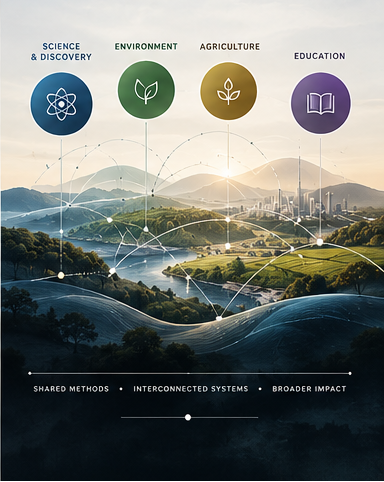
Intelligence increases research capacity. Evidence determines credibility.
Research should leave a trail
Provenance
Important research outputs should retain information about where evidence originated, how it was processed and which assumptions contributed to a result.
Reproducibility
Where practical, methods should be documented sufficiently for another researcher or system to understand how a conclusion was reached and attempt to reproduce it.
...
This becomes particularly important when research is computational, automated or supported by artificial intelligence.
Research Can Become Systems
From investigation to application
AeonCore research is not separated from implementation.
When an idea becomes sufficiently mature, it may move from theoretical investigation into experimentation, prototypes and eventually operational systems.
The transition creates a valuable feedback loop: research informs implementation, while real-world implementation exposes assumptions and constraints that theoretical work may have missed.
When an idea becomes sufficiently mature, it may move from theoretical investigation into experimentation, prototypes and eventually operational systems.
The transition creates a valuable feedback loop: research informs implementation, while real-world implementation exposes assumptions and constraints that theoretical work may have missed.
Research →
Experiment →
Prototype →
Operational System →
Evidence →
Research Across AeonCore
Research already takes different forms across AeonCore
Current public AeonCore domains illustrate how the research approach adapts to very different questions.
Scientific exploration
Computational investigation of theoretical scientific questions, including extreme atomic systems and areas where direct experimentation may not currently be possible.
Environmental research
Investigation of interconnected ecological, environmental and human systems, including resilience, regeneration and systemic consequences.
Applied agricultural research
Exploration of relationships between farming activity, environmental conditions, productivity, traceability and regenerative outcomes.
Learning and capability research
Investigation of how knowledge, learner needs, pathways, assessment, skills and demonstrated capability can be connected within intelligent educational systems.
These represent current public examples rather than the limits of AeonCore research.
Research Should Challenge Itself
The purpose is not to prove ourselves right
Confirmation bias is a risk in every form of research.
AeonCore should actively seek evidence that challenges its own assumptions and models rather than evaluating only evidence that supports them.
Competing explanations should be considered where credible alternatives exist, and conclusions should change when better evidence becomes available.
AeonCore should actively seek evidence that challenges its own assumptions and models rather than evaluating only evidence that supports them.
Competing explanations should be considered where credible alternatives exist, and conclusions should change when better evidence becomes available.
A model that cannot be challenged is not a research model.
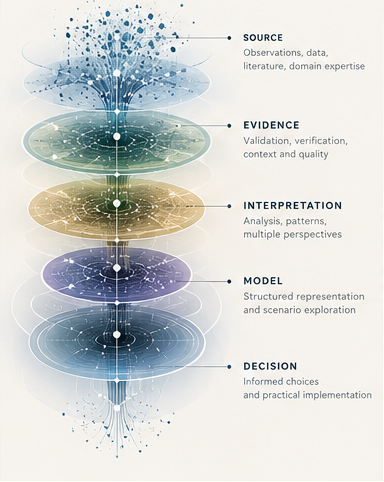
Innovation Means More Than New Technology
Innovation can happen at different levels
New Knowledge
Discovering relationships, evidence or explanations that were previously unknown.
New Methods
Developing better ways to investigate, model, measure or evaluate complex systems.
New Systems
Turning research into technologies, services or infrastructure capable of creating practical value.
Innovation is useful when it improves what we can understand or what people can meaningfully do.
Collaboration
Research improves through collaboration
Complex questions benefit from diverse expertise.
AeonCore is intended to support collaboration between researchers, educators, technologists, organisations, institutions and domain specialists where shared investigation can produce better understanding.
Collaboration does not require every participant to share the same hypothesis. Productive research often begins precisely because different explanations exist.
AeonCore is intended to support collaboration between researchers, educators, technologists, organisations, institutions and domain specialists where shared investigation can produce better understanding.
Collaboration does not require every participant to share the same hypothesis. Productive research often begins precisely because different explanations exist.
Agreement is not a prerequisite for investigation.
Responsible Research
Research also has responsibilities
Ethics
The ability to investigate something does not automatically mean every method of investigation is appropriate.
Privacy
Research involving personal or sensitive information requires appropriate protection and legitimate use.
Security
Research outputs and technologies should be considered in terms of both intended and potential misuse.
Impact
Researchers should consider who may be affected if an experimental idea becomes an operational system.
Toward a Wider Research Environment
Research as connected knowledge
Over time, AeonCore aims to make research itself easier to explore across disciplinary and institutional boundaries.
Scientific literature, experimental results, competing hypotheses, unconventional research, datasets and computational models often exist in separate environments.
A future research system could help connect these materials without treating every claim as equally established — preserving the distinction between evidence, hypothesis, criticism, replication and consensus while making the relationships between them easier to investigate.
Scientific literature, experimental results, competing hypotheses, unconventional research, datasets and computational models often exist in separate environments.
A future research system could help connect these materials without treating every claim as equally established — preserving the distinction between evidence, hypothesis, criticism, replication and consensus while making the relationships between them easier to investigate.
The goal is not to decide which ideas people are allowed to explore. It is to make the evidence surrounding those ideas clearer.
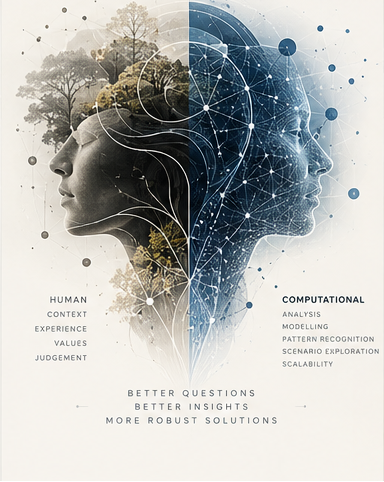
Ask difficult questions. Follow the evidence.
AeonCore research is driven by curiosity, but curiosity alone is not enough.
Progress requires questions that can be examined, methods that can be criticised, evidence that can be traced and conclusions that remain open to revision.
That combination — curiosity and discipline — is the foundation of research across the AeonCore ecosystem.
Progress requires questions that can be examined, methods that can be criticised, evidence that can be traced and conclusions that remain open to revision.
That combination — curiosity and discipline — is the foundation of research across the AeonCore ecosystem.
Explore freely.
Test rigorously.
Learn continuously.