The AeonCore Framework
The AeonCore Framework is the shared conceptual foundation connecting AeonCore's different research domains and operational systems. It provides a common way to approach complex problems while allowing each domain to develop the specialist knowledge, models and technologies it requires.
Explore the AeonCore Framework: a shared approach to knowledge, evidence, modelling, simulation and human-centred intelligent systems across multiple domains.
THE AEONCORE FRAMEWORK
A common foundation for very different problems.
Scientific research, environmental systems, agriculture and education may appear unrelated.
Yet each involves knowledge, evidence, relationships, uncertainty, changing conditions and decisions made within complex environments.
The AeonCore Framework provides a shared approach for working with those challenges.
Yet each involves knowledge, evidence, relationships, uncertainty, changing conditions and decisions made within complex environments.
The AeonCore Framework provides a shared approach for working with those challenges.
Different systems.
Common principles.
Adapted intelligence.
What the AeonCore Framework is
The AeonCore Framework is not a single software platform, algorithm or artificial intelligence model.
It is a set of research, design and systems principles that guide how AeonCore projects represent knowledge, connect evidence, explore relationships, model possibilities and support human decision-making.
Individual AeonCore systems may therefore use very different technologies while still sharing the same underlying approach.
It is a set of research, design and systems principles that guide how AeonCore projects represent knowledge, connect evidence, explore relationships, model possibilities and support human decision-making.
Individual AeonCore systems may therefore use very different technologies while still sharing the same underlying approach.
The framework defines how we approach problems...
...not one mandatory technology for solving them.
The Framework Cycle
From observation to understanding
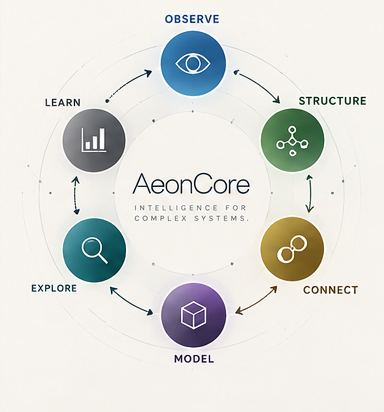
AeonCore systems generally move through a recurring cycle rather than a simple linear process.
Observe
Gather relevant information, measurements, knowledge or evidence from the system being studied.
Structure
Organise information so that context, relationships and provenance remain meaningful.
Connect
Identify dependencies and interactions between relevant entities, variables, concepts or events.
Model
Develop representations that help explain how parts of the system may interact.
Explore
Examine scenarios, possibilities, consequences and uncertainty through analysis or simulation.
Learn
Compare models and assumptions with outcomes, evidence and new observations so the system can be refined.
Observe → Structure → Connect → Model → Explore → Learn → Observe again
Knowledge in Context
Knowledge needs context
A piece of information has limited value if the system does not understand what it describes, where it came from, how it relates to other information and under what conditions it remains valid.
AeonCore therefore treats knowledge as more than isolated records.
Depending on the domain, meaningful context may include relationships between concepts, observations, people, places, events, skills, environmental conditions, scientific hypotheses or historical states.
AeonCore therefore treats knowledge as more than isolated records.
Depending on the domain, meaningful context may include relationships between concepts, observations, people, places, events, skills, environmental conditions, scientific hypotheses or historical states.
nformation becomes knowledge when relationships and context remain visible.
Evidence and Provenance
Evidence should travel with the claim
Evidence
Wherever practical, AeonCore systems should connect important conclusions to the evidence supporting them.
Evidence may take many forms: measurements, observations, validated records, demonstrated outcomes, research literature or verified events.
Evidence may take many forms: measurements, observations, validated records, demonstrated outcomes, research literature or verified events.
Provenance
Knowing the source of information can be as important as knowing the information itself.
Provenance helps distinguish direct observation from imported data, inference, modelling, interpretation or third-party claims.
Provenance helps distinguish direct observation from imported data, inference, modelling, interpretation or third-party claims.
Relationships Before Isolation
Relationships matter
Many systems become difficult to understand because the behaviour of one part depends on conditions elsewhere.
AeonCore therefore places emphasis on relationships and dependencies rather than treating every variable as independent.
In agriculture, this might mean connections between soil, weather, crops, inputs and management decisions.
In education, it might mean relationships between prior knowledge, learning outcomes, skills, evidence and individual pathways.
In scientific research, it may involve relationships between observations, theoretical models and competing explanations.
AeonCore therefore places emphasis on relationships and dependencies rather than treating every variable as independent.
In agriculture, this might mean connections between soil, weather, crops, inputs and management decisions.
In education, it might mean relationships between prior knowledge, learning outcomes, skills, evidence and individual pathways.
In scientific research, it may involve relationships between observations, theoretical models and competing explanations.
A system is more than the sum of the data stored inside it.
Models Are Tools, Not Reality
Models are representations, not truth
Every model simplifies reality.
The purpose of modelling is not to create a perfect copy of the world, but to create a useful representation that helps investigate a particular question.
AeonCore systems should therefore preserve awareness of assumptions, limitations, uncertainty and the conditions under which a model is intended to be useful.
The purpose of modelling is not to create a perfect copy of the world, but to create a useful representation that helps investigate a particular question.
AeonCore systems should therefore preserve awareness of assumptions, limitations, uncertainty and the conditions under which a model is intended to be useful.
A useful model explains what it can tell us, and what it cannot.
Exploring Possibilities
From models to exploration
Once relationships have been represented, systems can begin exploring possible states and consequences.
Scenarios
Examine how a system may behave under different assumptions, inputs or conditions.
Sensitivity
Identify which variables or relationships have the greatest influence on outcomes.
Consequences
Explore how changes in one part of a system may create effects elsewhere.
The purpose is not to claim certainty about the future, but to make possible consequences easier to examine before decisions are made.
Uncertainty Is Information
Uncertainty should not be hidden
Complex systems rarely provide complete information.
Measurements may be imperfect. Data may be missing. Models may disagree. Conditions may change.
AeonCore treats uncertainty as part of the information available to decision-makers rather than something that should automatically be disguised behind a definitive answer.
Measurements may be imperfect. Data may be missing. Models may disagree. Conditions may change.
AeonCore treats uncertainty as part of the information available to decision-makers rather than something that should automatically be disguised behind a definitive answer.
Knowing what is uncertain can be as valuable as knowing what appears certain.
Human Intelligence + Machine Intelligence
Different forms of intelligence
Machines can examine volumes of information, detect patterns, run simulations and evaluate combinations that would be impractical for people to process manually.
Computational Intelligence
Machines can examine volumes of information, detect patterns, run simulations and evaluate combinations that would be impractical for people to process manually.
Human Intelligence
People contribute judgement, ethics, purpose, contextual understanding, experience and responsibility.
Computation expands the field of view. Humans determine what matters.
AeonCore is designed around the interaction between these capabilities rather than assuming one should replace the other.
Domain Adaptation
One framework, adapted to each domain
The framework remains consistent, but its implementation changes according to the problem being addressed. Current examples include:
Scientific systems
Knowledge may consist of theoretical models, experimental evidence, scientific literature and computational exploration.
Environmental systems
Knowledge may include ecosystems, environmental measurements, human activity, geography, emissions, resilience and regeneration.
Agricultural systems
Knowledge may include land, crops, climate, practices, inputs, productivity, traceability and environmental evidence.
Educational systems
Knowledge may include learning outcomes, skills, resources, assessment, learner needs and demonstrated capability.
Current Systems
These are the currently visible domains. The AeonCore Framework is designed to support additional fields as they are developed.
The Framework Is Modular
Built to evolve
AeonCore does not assume that the technologies available today will remain the best tools tomorrow.
The framework is therefore intended to be modular and adaptable.
New models, data sources, analytical methods and intelligent technologies can be incorporated as research develops, provided they continue to support the wider principles of evidence, transparency, context and responsible use.
The framework is therefore intended to be modular and adaptable.
New models, data sources, analytical methods and intelligent technologies can be incorporated as research develops, provided they continue to support the wider principles of evidence, transparency, context and responsible use.
Principles should endure longer than individual technologies.
Research Feedback Loop
Systems should learn from reality
Operational systems create an important opportunity: ideas can be tested against actual use rather than remaining purely theoretical.
Research
Develop concepts, hypotheses and models.
Implementation
Translate those ideas into tools, experiments or operational systems.
Observation
Examine how the systems perform under real conditions.
Evaluation
Compare expected outcomes with observed evidence.
Refinement
Improve the research, models and systems based on what was learned.
Research informs systems. Systems create evidence. Evidence improves research
What the Framework Does Not Claim
Perfect Information
Real systems are incomplete. AeonCore does not assume every relevant variable will always be known.
Perfect Models
Models are tools designed for purposes and conditions, not permanent descriptions of reality.
Automatic Objectivity
Algorithms inherit assumptions from data, design and objectives. Those assumptions should remain open to examination.
Universal Solutions
A method appropriate for one domain or context may be inappropriate in another.
A framework for understanding before acting
The AeonCore Framework connects knowledge, evidence, relationships, modelling and exploration into a common approach to complex systems.
Its purpose is not to produce one universal answer.
It is to provide better ways of asking questions, examining possibilities and understanding the consequences of decisions across many different domains.
Its purpose is not to produce one universal answer.
It is to provide better ways of asking questions, examining possibilities and understanding the consequences of decisions across many different domains.
Observe carefully. Connect meaningfully.
Model responsibly.
Decide with understanding.